EXECUTIVE SUMMARY
- AI is creating multiple data center workload profiles — broadly falling into the categories of training and inference — each with distinct characteristics.
- AI training facilities can undergo millisecond changes in power demand — synchronized across entire GPU clusters.
- AI inference applications can exhibit more distributed spikes in power demand from separate user-driven requests.
- Regarding backup power infrastructure, data centers must specify UPS energy storage which matches the workload profile of the application.
- With a broad portfolio of solutions, EnerSys can help guide data centers towards the right UPS energy storage system using a workload-led approach.
The differences between power-dense training and low-latency distributed inference show why the AI era calls for workload-led UPS battery selection
AI is not creating a single new data center power problem. It is creating multiple power profiles. Large-scale training workloads can produce fast, synchronized demand swings across GPU clusters, while inference workloads are often more distributed, latency-sensitive, and site-dependent. For UPS energy storage selection, that distinction matters.
In some instances, UPS energy storage must be specified not only for the scale of power demand, but also for the speed at which demand can change. AI training data centers may require systems capable of supporting fast, repeated high-power transients as part of a wider dynamic load-response strategy.
However, some AI data centers may also benefit from established UPS energy storage technologies, including advanced lead-acid. Unlike training, inference applications may not create the same synchronized cluster-level peaks as large training runs, suggesting some existing data center sites could be suitable for inference-oriented retrofits, depending on power density, cooling, network latency, redundancy, and operational requirements.
In the AI era, the right UPS battery choice is less about choosing a single preferred chemistry and more about matching technology to workload behavior, site constraints, and resilience requirements.
Training vs. inference
Some forecasts suggest AI-related electricity demand could grow roughly tenfold by 2030.1 That demand broadly falls into two categories — training and inference — each shaping infrastructure requirements slightly differently.
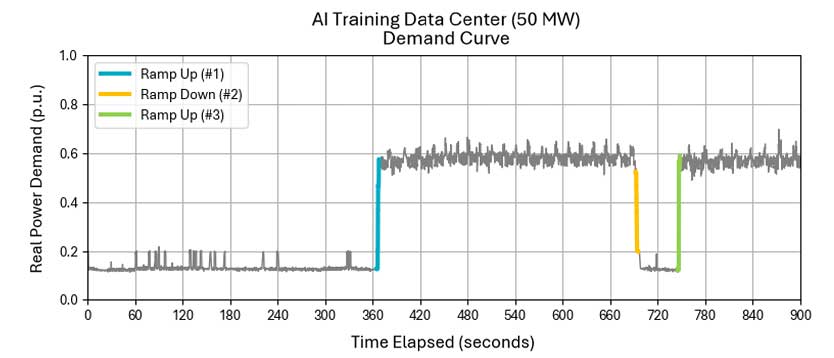
An AI training data center begins a training run
Training — the process of developing and refining AI models — typically requires large-scale, high-density infrastructure built around tightly synchronized GPU clusters, advanced cooling and substantial electrical capacity. Because training workloads are generally less latency-sensitive than live inference services, they may be better suited to large campuses in power-rich locations where land, grid capacity, and cooling infrastructure can be scaled.
Inference — the stage at which trained models are deployed into live applications — is more latency-sensitive, which means inference capacity may be deployed closer to users, networks, and data sources, including metro, near-metro, cloud, and edge environments.
McKinsey expects power demand from inference to overtake training and account for more than half of AI workloads by 2030. However, demand for both applications will grow in absolute terms.2
The AI power challenge is not just bigger loads, but faster ones
While inference is pushing AI into more places, training is helping redefine power infrastructure. The issue is not simply that AI training consumes a great deal of electricity — it is that demand can rise to an enormous scale and change with extreme speed.
Frontier training clusters are already operating at power levels that would once have been associated with an entire facility rather than a single workload. High-density AI deployments are pushing far beyond traditional assumptions, with workloads requiring around 100-200kW per rack3 . One GPU model — scheduled for release in the second half of 2027 — could reach 600kW per rack.4 Meanwhile, 1MW racks could arrive as soon as 2028.5
Meanwhile, at the campus level, a single training run can require 100-150MW of power, with that number estimated to rise to around 4GW by 2030.6 But scale is only half the story. AI training loads can also shift in sub-second intervals, particularly as systems move between active computation and checkpointing. Those transitions create sharp ramp events that place very different demands on electrical infrastructure than the steadier profiles associated with conventional data center environments.7
That matters because many traditional backup power architectures were not designed around this kind of behavior. In conventional UPS deployments, batteries have often been treated primarily as a reserve asset; they wait in the background, discharge during an outage, and otherwise remain largely passive. AI training challenges that model. When loads are highly dynamic, batteries may need to do more than provide ride-through during utility failure; they may need to support the system in managing rapid fluctuations in demand as part of normal operation.
This is why AI cannot be addressed simply by scaling up traditional backup designs. The paradigm shift is architectural, not incremental. In training environments especially, operators may need battery technologies that can respond quickly, tolerate more frequent cycling, and contribute to system-level stability rather than functioning only as emergency standby. In that context, lithium-based UPS energy storage systems are drawing increased attention because they can be engineered for high power density, fast response, high discharge rates, and frequent cycling as part of a wider UPS architecture.
The broader implication is that AI infrastructure will not be served by a one-size-fits-all UPS energy storage strategy. Different AI environments place different stresses on power systems. Training workloads, with their scale and volatility, may justify more dynamic battery technologies at system level, while other environments may prioritize different performance characteristics. As AI data centers diversify, UPS energy storage selection will increasingly become a question of workload fit, not just runtime or upfront cost.
Inference: A role for established battery technology?
AI inference creates a different infrastructure challenge from training. Rather than one large, highly synchronized workload, inference is typically driven by many separate user requests, and production research suggests that, at cluster level, inference can retain meaningful power headroom even when individual servers experience sharp peaks.8
For UPS design, that distinction matters for two key reasons.
First, the behavior of inference power at system level suggests that UPS batteries could play a role similar to those already deployed in traditional data centers—standby power ready to kick in should an unexpected outage occur, rather than as regular participants in load-smoothing.
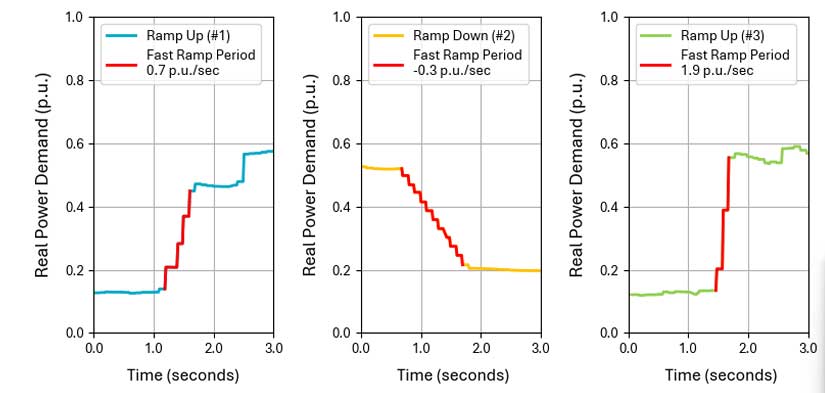
Zoomed-in views of AI training data center ramping up and down
Second, given the similarities with traditional data centers, inference applications may be deployed in existing retrofitted sites. In such cases, established UPS energy storage technology could be more practical to deploy compared with newer systems, which may introduce different regulatory, integration, or logistical considerations.
Inference does not automatically invalidate established UPS energy storage technologies. In many inference environments, the UPS energy storage system may still be specified primarily for standby backup, reliability, serviceability, safety, footprint, cost, and retrofit practicality. In those cases, advanced lead-acid technologies, including Thin Plate Pure Lead (TPPL), may remain a highly practical choice. But inference will likely not be uniform. Some deployments may be denser and more operationally demanding than others — and in those cases, established battery technologies may not be optimal, potentially making lithium-based energy storage systems the better fit.
A workload-led approach to UPS battery selection
The differences between power-dense training and low-latency distributed inference show why the AI era calls for workload-led UPS energy storage selection.
Training environments may place greater emphasis on fast response, high discharge rates, frequent cycling, and system-level dynamic performance. Inference environments may place greater emphasis on availability, serviceability, safety, retrofit practicality, lifecycle cost, and proven standby performance. Mixed AI estates may require different UPS energy storage strategies across different sites, workloads, and deployment models.
As a key player in the data center UPS energy storage market, EnerSys supports a workload-led approach — helping operators assess whether their environment calls for advanced lead-acid, lithium-based UPS energy storage, or a hybrid technology strategy across different sites and applications.